The AI Skills Gap: 79% of Employers Want Mid-Level AI Skills
Quick answer:
A new Schultz Family Foundation study shows 79% of businesses want entry-level hires with mid-level AI skills or better — yet slightly less than half of young adults feel their schooling met that bar. According to GeekWire (November 27, 2026), the study of nearly 3,000 interviews also found that more than 80% of employers are interested in internships and apprenticeships, but 77% say they lack the staff time to run them. The message for managers, employees and families is clear: AI skill is no longer a résumé bonus — it is the entry ticket to the job market.
The AI skills gap is the gap between you and tomorrow's job opportunities. To design a learning roadmap for your organization or family, talk to DigiNoron's specialists.
Request a ConsultationWhat does the new Schultz Family Foundation study say?
Released Monday (November 23, 2026) by the Schultz Family Foundation, the study is based on nearly 3,000 interviews with young adults, employers and workforce actors in Washington state. Its core finding: 79% of businesses expect entry-level workers to have mid-level AI skills or better, while fewer than half of the surveyed young adults said their education reached that level.
What makes this significant is that the numbers come from employers themselves, not media analysts. "AI skill" has moved from a nice-to-have preference to an actual hiring criterion — much like computer literacy two decades ago. Anyone entering the job market without it is competing in a game where many of their peers already run ahead.
What does the gap look like in numbers?
Put together, the study's numbers draw a complete gap: on the demand side, 79% of employers want AI skills; on the supply side, fewer than 50% of young adults feel qualified; in between, over 80% of employers want internships and apprenticeships, but 77% say they lack the staff time to run them. Neither schools nor companies are ready.
Which means waiting is futile: if schools are confused and companies have no time, responsibility for closing the gap quietly transfers to individuals and families. The good news is that this institutional vacuum is the biggest opportunity for those who start early — the same logic we explained in our article on the right age for kids to start learning AI.
Why training workers alone is not enough — Arif Gursel's twist
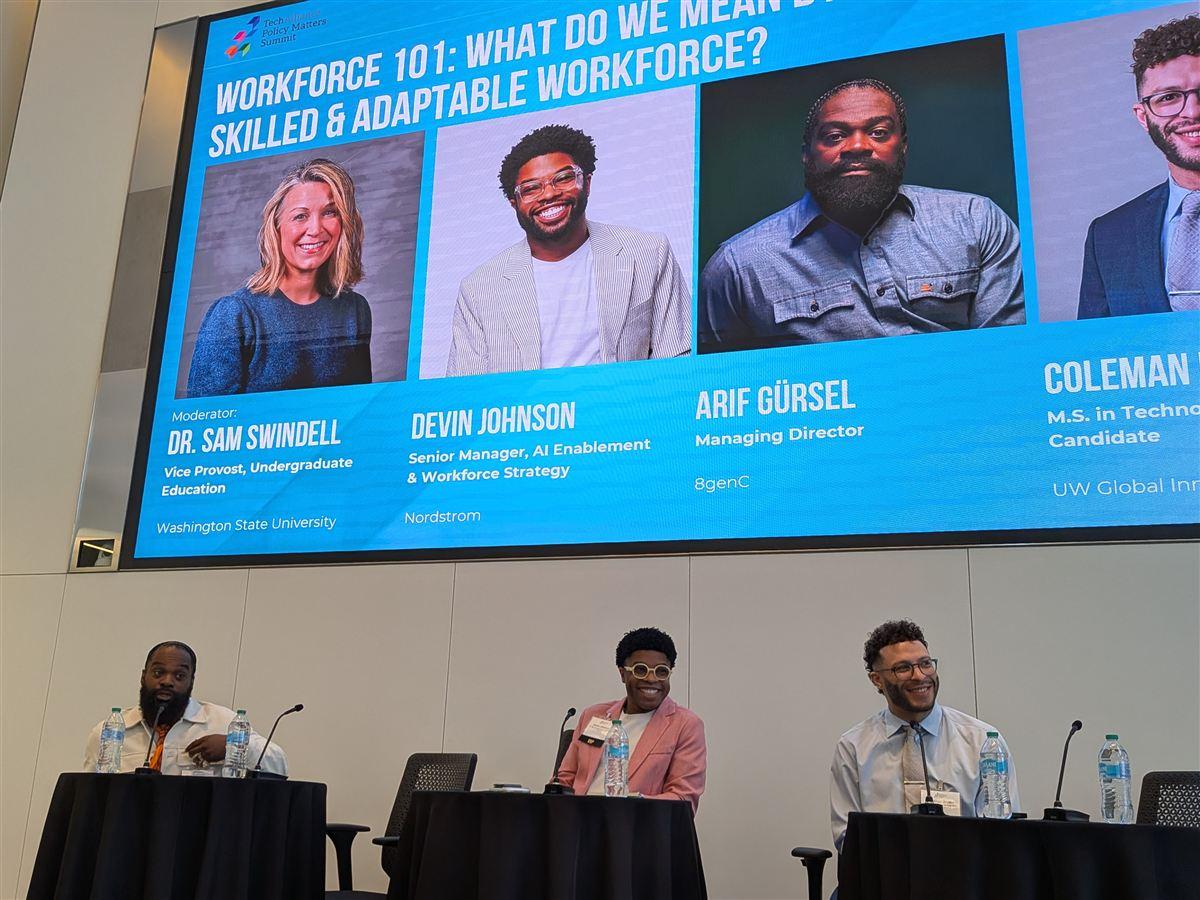
Arif Gursel, a serial entrepreneur and founder of the corporate strategy firm 8genC who spent more than a decade at Microsoft, told the panel something striking: "A skilled and adaptable workforce also needs a skilled and adaptable workplace. Those things have to be in balance." In his view, preparing people for technological change cannot fall entirely on students, universities or employees — employers must change too.
That is the exact mistake repeated in many enterprise AI projects: the company buys a training course, the employee completes it, then returns to an environment with no process or tooling to use what was learned. The skill evaporates. In DigiNoron's enterprise AI projects we start precisely there: prepare the environment and processes first, then train — not the other way around.
Schools are sending mixed signals
One of the study's most curious findings: about as many young adults said their institution discouraged AI use (36%) as said it helped them learn to use it (34%). An entire generation is receiving two contradictory messages about a tool that is becoming ubiquitous.
Coleman Bryant, a technology innovation master's candidate at the University of Washington, warned on the same panel that students can end up "offloading all of the critical thinking to the AI," and called for hands-on, interdisciplinary education that connects technical knowledge with business, design and collaboration. That is exactly the philosophy behind DigiNoron's AI courses for kids and teens: a child should not become just a tool user — they must remain the thinking designer.
The digital divide is widening because of AI
Gursel also warned about equitable access: underserved and marginalized communities — including tribal, indigenous, Black and Brown communities — have less access to AI tools. "How do we build the bridge for that digital divide that is just widening as a result of AI?" A question that applies to every market in the world, not just America.
The lesson for any society is clear: the faster AI spreads through the workplace, the wider the distance grows between those who have access to tools and training and those who do not. Families and organizations investing today are in fact working to shrink that distance for their children and colleagues — and this investment is no longer a luxury; it is future insurance.
The proven fix: co-designing education with employment
Gursel also shared a field-tested model: he partnered with a Microsoft hiring manager, they co-developed a curriculum, and the manager committed two open positions to its graduates. Ingrid Stegemoeller of the Washington Roundtable's Partnership for Learning added that if employers share clear signals about the skills they need with schools and colleges, that participation can become coursework and work-based learning.
The organizational version of this pattern is simple: before buying a course, identify which roles will use which AI tools and what the expected output is; build the training around those real scenarios; then hand the team a real project. We run this step by step in DigiNoron's private AI courses for managers; the organizational framework is in our article why leaders must learn AI before their projects fail.
What does this mean for managers, employees and parents?
It is tempting to file this under "American statistics" — but the structure is universal: employers want it, schools lag, companies lack time. For managers: teams fluent in AI deliver more output at the same cost and are the last to be made redundant. For employees: AI skill is the newest competitive layer. For parents: your child will compete in a version of the job market where AI is the default.
The good news: the gap is defined as "mid-level" skill — not a PhD in machine learning. Working with smart assistants, practical prompt engineering, building simple automations and understanding model limitations are exactly the level 79% of employers are asking for. Starting earlier than the crowd means that by the time others reach mid-level, you are a step ahead.
The AI skills gap in numbers (Schultz Family Foundation study)
| Indicator | Figure | What it means for you |
|---|---|---|
| Employers wanting mid-level AI skills | 79% | AI skill is now a hiring criterion |
| Young adults who feel qualified | Under 50% | Skill supply lags demand — opportunity for early starters |
| Employers interested in internships/apprenticeships | Over 80% | The hands-on entry path is open; project-based résumés pay off |
| Employers lacking staff time to run them | 77% | Don't wait for "the company program"; start yourself |
| Schools discouraging AI vs. helping learn it | 36% vs. 34% | Official signals are confused; the decision belongs to families and individuals |
Both your organization and your children can stand on the right side of this gap. Design your learning roadmap with DigiNoron.
Request a Consultation5 common traps organizations fall into with AI skills
Trap 1: Treating AI as an IT-department problem
The study shows employers want AI skills from "entry-level" people in every role — from marketing to HR. When training is confined to the technical team, you forfeit 79% of the market's real demand.
Trap 2: Buying tools instead of building skills
An AI tool license without the skill to use it is pure cost. Gursel's point exactly: the workplace must adapt too; tool, process and skill have to arrive together.
Trap 3: Generic training disconnected from real work
The Microsoft–8genC experience showed training works when it is tied to a real job role and a job commitment. A course that ends without a real project is forgotten within three months.
Trap 4: Banning AI at work or school
36% of schools discouraged AI — and in practice only built hidden usage. An organization that bans AI does not stop the behavior; it just makes it invisible — without guidance or standards.
Trap 5: Expecting ready workers without investing
77% of employers say they lack staff time for internship programs, yet still expect job-ready hires. This loop never breaks itself: either invest the time, or co-design programs with specialist partners.
Frequently asked by users (voice search)
What is the AI skills gap?
The distance between the skills employers expect (in this study, mid-level AI skills for 79% of entry-level jobs) and the skills the workforce actually has; the Schultz Family Foundation study found fewer than half of young adults feel qualified.
What percentage of employers want AI skills?
Per the Schultz Family Foundation study (November 2026, nearly 3,000 interviews in the US), 79% of businesses expect entry-level workers to have mid-level AI skills or better.
Why does employee AI training fail?
Because training is not connected to the workplace: employees finish the course but the processes, tools and management expectations needed to apply it are not there. The fix is co-designing training with real job roles.
Where should we start?
With a simple assessment: map your organization's roles — or your child's age — to the AI tools and skills they need, then run a staged path (fundamentals → tools → real project). DigiNoron's consultation builds exactly this roadmap.
79% of employers are waiting for AI-capable talent. Put your organization and family on the right side of the gap — with DigiNoron.
Request a ConsultationFAQ
What exactly does the AI skills gap mean?
It is the distance between employer expectations and the workforce's real skills. In the Schultz Family Foundation study (November 2026), 79% of businesses want mid-level AI skills from entry-level hires, while fewer than half of young adults said their education met that bar.
When, where and how was the study conducted?
The Schultz Family Foundation released it on Monday, November 23, 2026; based on nearly 3,000 interviews with young adults, employers and workforce actors in Washington state, covered by GeekWire.
What does "mid-level AI skill" mean?
Practical work with smart assistants, effective prompt writing, building simple automations and understanding model limitations — not machine-learning expertise. Per the study, that is what most employers expect across roles.
Where should our organization start?
Take it from Gursel: the workplace must adapt too. First map key roles and processes, build training around their real scenarios, then assign a real project after the course. DigiNoron's private manager courses follow exactly this structure.
What is the lesson for kids and teens?
From the UW master's student: the risk of "offloading all critical thinking to AI" is real. Kids' education must be hands-on and interdisciplinary so the child remains the thinking designer, not just a tool consumer — the approach of DigiNoron's kids and teens courses.

DigiNoron Specialist Team
5+ years of hands-on AI projects
The DigiNoron specialist team, drawing on real AI projects across industries, produces articles and courses that upgrade the digital skills of managers, employees and enthusiasts.
DigiNoron Specialist Team
5+ Years of AI Project Experience